
If you've heard “containment” and “negative air” and wondered what that looks like in a real house, this page is for you. Remediation is a controlled cleanup — not a scare pitch and not a promise to sterilize a home forever. The aim is to remove growth, protect clean rooms during the work, and leave materials dry enough that mold is less likely to return. Aligns with the EPA idea: clean up mold and fix the water problem.
The short version — what remediation is trying to do
Controlled removal of mold growth, plus moisture correction, while limiting spread to clean rooms. You'll often see plastic barriers and hear filtration equipment. That craft protects the rest of the house while work happens in the affected zone.
A homeowner-level process
Industry professional mold remediation is commonly framed for homeowners in five calm steps. This summary maps to publicly shared principles associated with ANSI/IICRC S520. It is not a substitute for the standard, and we do not paste or reconstruct the paid S-520 text.
- Assess moisture — Find and stop the water or humidity source; understand what's wet and where growth is.
- Contain / limit spread — Isolate the work area; use negative air / HEPA as appropriate so disturbance doesn't travel.
- Remove — Clean hard surfaces; remove contaminated porous materials that can't be dried and cleaned (EPA / CDC homeowner framing).
- Dry — Dry structure and contents thoroughly so materials stop feeding growth.
- Verify — Moisture problem fixed; no visible mold or musty odor as a practical judgment — not a lab “clearance number.” Independent assessment when used. We don't invent clearance certificates or guarantees.
Why moisture comes first (and last)
If the leak, condensate, or humidity driver stays, growth returns. The EPA says it plainly: clean mold without fixing the water problem, and mold most likely comes back. Bridge to prevention and DIY vs pro.
What is containment?
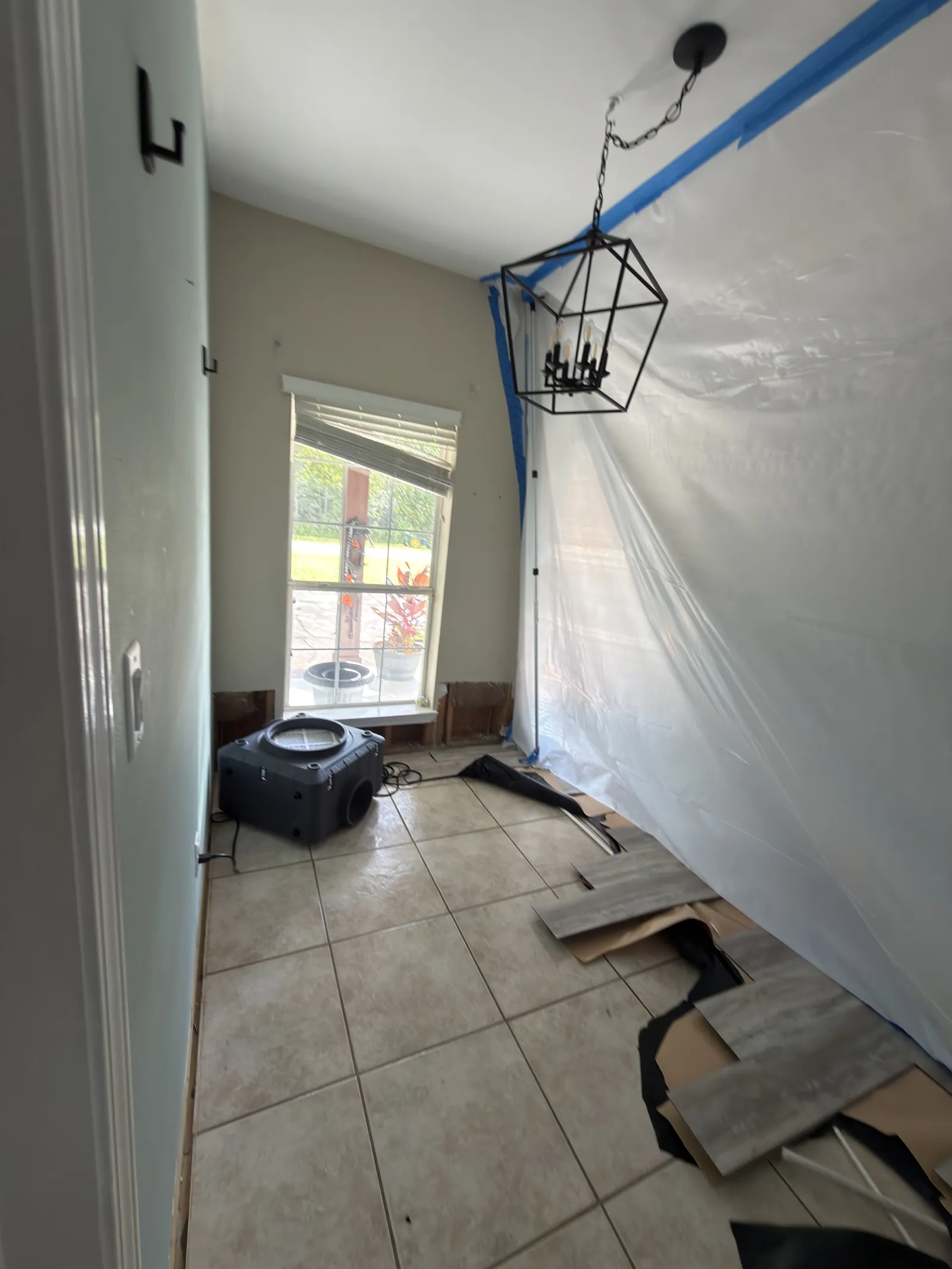
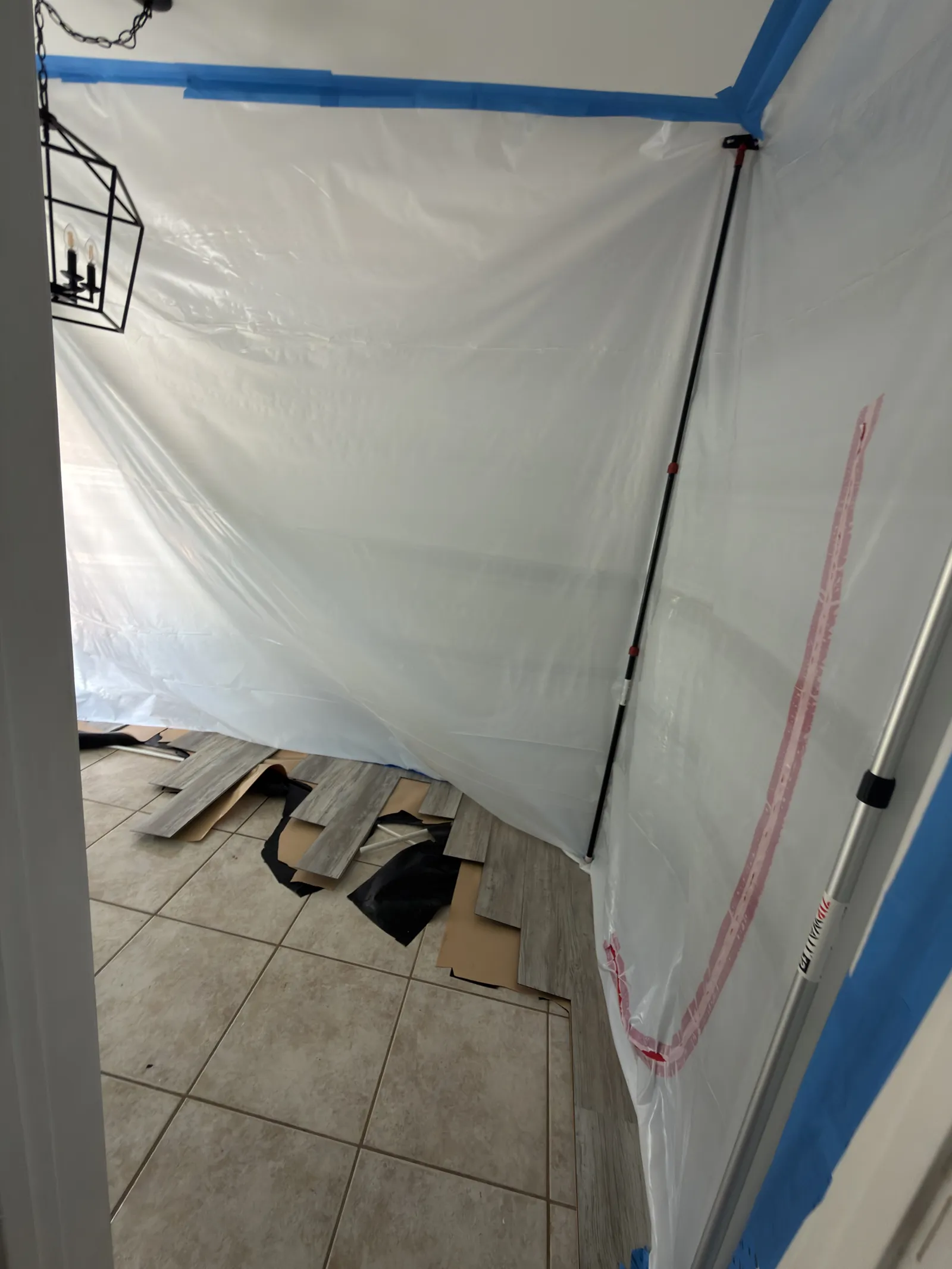
Containment means sealing the mold work zone off from the rest of the house — usually with polyethylene sheeting, sealed vents or openings in that zone, and a controlled entry — so particles stirred during removal don't drift into bedrooms, hallways, or HVAC returns. It's a practical barrier system, not a scare tactic. Limited vs fuller setups scale with job size and complexity; we describe the idea in plain English and point readers to EPA public guidance rather than inventing square-footage rules as Honest policy.
What you'll see at home
Plastic walls, taped vents, bags of debris, careful entry and exit. Temporary inconvenience protects the parts of the home that aren't in the work area.
Negative air pressure, plain English
Negative air pressure means the contained work area is kept at a slightly lower air pressure than the rooms around it, so air tends to flow into the work zone instead of out. Crews often use a HEPA-filtered machine that pulls air from inside containment and exhausts filtered air outdoors when practical. If containment is working, plastic barriers may billow inward. This is education only — not a claim that we “certify” pressure.
HEPA air scrubbing explained
Scrubbing and negative air are related but not identical. Scrubbing focuses on filtering air in the zone (often recirculating). Negative air focuses on that inward airflow — typically by pulling and exhausting — to reduce spread. One machine doesn't always do both jobs the same way on every project.
How professionals think about standard of care (IICRC S-520)
ANSI/IICRC S520 is a procedural standard for professional mold remediation of structures and contents. The public IICRC page lists topic areas professionals study — inspection, structural / HVAC / contents remediation, post-remediation verification, and more. For homeowners, the useful frame remains: assess moisture → contain → remove → dry → verify. Read the official overview at iicrc.org/s520. Professionals who need the full document purchase it through IICRC channels. Mentioning S-520 here does not imply a specific certification claim — it explains the idea of a professional process.
What remediation is not
- Not perfume or fragrance cover-ups
- Not painting or caulking over mold
- Not “kill it from the air” as a standalone fix
- Not storm-restoration theater on an education page
Re-center: remove growth, control moisture, protect clean areas.
DIY vs this process
Small hard-surface spots are often DIY territory. Larger, hidden, recurring, or HVAC-tied work is where controlled remediation belongs. Calm escalation cues live on DIY vs pro and the EPA cleanup page.
If you're unsure — talk straight
Call. We'll tell you straight. Text or call 850-686-6675. Soft next step: mold remediation. Also how to spot, what affects cost, and education hub.
Call. We'll tell you straight. · 850-686-6675
People first. Property second. · Est. 2018 · Veteran owned
Sources & standards
Prefer official .gov and IICRC pages over secondhand blogs. Practices change — check the live source.
- EPA — A Brief Guide to Mold, Moisture, and Your Home — moisture control & homeowner basics
- Florida Department of Health — Mold — Florida public-health guidance
- IICRC — About ANSI/IICRC S520 — professional mold remediation standard (info page; we do not reproduce the paid text)
- EPA — Mold Cleanup in Your Home
- CDC — Mold overview
- IICRC Webstore — ANSI/IICRC S520:2024 (purchase)
This page is education, not medical advice and not a substitute for ANSI/IICRC S520. Containment and negative air language here is educational only — no certification implications. Health symptoms → talk with a doctor.